

How much space does a sustainable office need?
Sustainability in the office is often thought of in terms of environmentally friendly, regionally produced office furniture and energy-efficient office buildings. But it starts much earlier: with the floor plan of the office. Officebox by neudoerfler makes office planning simpler and more thoughtful and helps to save space. The more efficiently the space is used, the more sustainable the office. Because every unnecessarily built, heated, cooled, illuminated and furnished area causes expense and resource consumption.


Almost a third of planned office space remains unused.
The Office Report 2025* by Team Gnesda reveals what is the reality in many organizations: office space is underused and too much is wasted. Working from home has become part of everyday working life, the office is the center for exchange and collaboration. Although people no longer work exclusively in the office, office space is still generously designed and workstations often remain empty.
Precise figures even show that the average rented office space per employee is 19.5 m². However, with a well thought-out concept, a benchmark of 14 m² per employee could usually be achieved without compromising on quality. This corresponds to a space-saving potential of 28%.
This is precisely where a major sustainability lever lies: if office space is planned more precisely, companies can avoid unnecessary space. Less space usually means fewer building materials, fewer interior fittings, less office furniture, lower energy requirements and lower running costs. At the same time, an office is created that better supports everyday working life. The budget saved can be invested in higher-quality equipment that will provide long-term benefits.

Good office planning doesn't ask: How many desks do we need?
Good office planning asks: Which activities really take place and which zones in the office best support them? A well-planned office is not just based on the number of employees. It is based on how people actually work.
- Where do you need desks for concentrated work?
- Where do spontaneous coordination meetings take place?
- How are visitors welcomed?
- Where are there tea kitchens for coffee breaks, lunch bowls and after-work drinks?
- Where should files and office supplies disappear discreetly into smart storage space?

Less space, but higher quality (office) furniture.
Only when these questions have been clarified does space really become effective. This approach changes the way we look at office space. To be able to work well, you don't necessarily need a lot of space. The aim is to create well-planned offices that meet the requirements of the teams that work there.

Office furnishing made radically simple with Officebox.
With Officebox, neudoerfler makes office planning noticeably easier. Instead of putting together office furnishings from many individual decisions, typical office areas are planned as well thought-out boxes: from workstations and meeting rooms to storage space, telephone areas, kitchens or cafés. The selected office boxes are professionally planned into the floor plan and tailored to actual requirements. Easy, fast, clear.
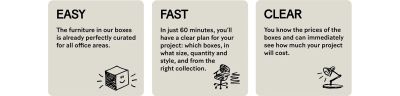
The 60-minute meeting quickly provides an initial clear orientation: which boxes fit into the floor plan and what costs can be expected. Because experienced office planning experts have already done the preliminary work. Now it's just a matter of selecting the boxes and off they go.
For companies, this means more clarity in planning, more certainty when making decisions and an easier way to create office furnishings that make economic and ecological sense. Because sustainable offices are not just the result of better materials. They are created by better planned offices.
Or to put it another way: the most sustainable square meter is often the one that a well-planned office doesn't even need.
Curious? Then discover Officebox by neudoerfler.
Sources:
*Office Report 2025: teamgnesda, Andreas Gnesda, Oliver Bertram. Company survey 03-05/2025. survey partners: pro m² GmbH, Vitra International GmbH.